

Description:
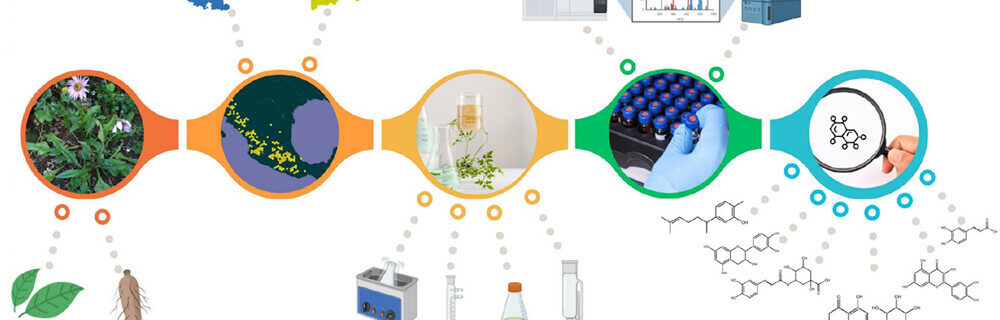
The aim is to present and practice different analytical chemistry methods enabling the characterisation of primary or secondary metabolites, and their valorisation. The course will be split between theoretical sessions and practical sessions. In particular, the rational for the choice between different protocols will be compared whether the objective is to perform omics or targeted analysis. Their selectivity for the types of metabolites will be discussed (polar, lipid, polysaccharides, terpenes, etc…). The training will contain:
During the practical sessions, the students will identify an unknown metabolite (targeted approach) and will compare the composition of two model mixtures (omics approach) using HPLC, GC, NMR and FT-IR. The students are invited to contact the teachers to bring their own biomass for the extraction and identification of the natural product(s) of their interest.
At the end of the training, the students will be able to extract, partially purify, identify and quantify specific metabolites from their organism of interest (micro- or macroorganisms, from bacteria, yeast, microalgue, plants, insects, etc…). They will be able to adapt the extraction protocol(s) to the biological question (omics/targeted, yield/identification…). They will have knowledge on the complementarity between various analytical methods such as: TLC, GC-MC, HPLC-MS, NMR, FT-IR. They will also be able to design strategies to valorise these natural products by the design of clever hemi-synthesis protocols (as opposed to full synthesis).
Prerequisites
